
Genshin Impact's Miliastra Wonderland Unleashes Roblox-Style UGC Creation
Genshin Impact's Miliastra Wonderland mode offers user-generated content and cosmetics, echoing Roblox's creativity in Teyvat.
Genshin Impact has never been shy about experimenting with new modes, but version 6.1 \u2013 which went live last October \u2013 brought its most ambitious diversion yet. Miliastra Wonderland is a sprawling user-generated content hub that lets players design, share, and play custom stages. It\u2019s permanent, it\u2019s packed with cosmetics, and it\u2019s clearly HoYoverse\u2019s take on the Roblox formula, built right into Teyvat\u2019s own universe.
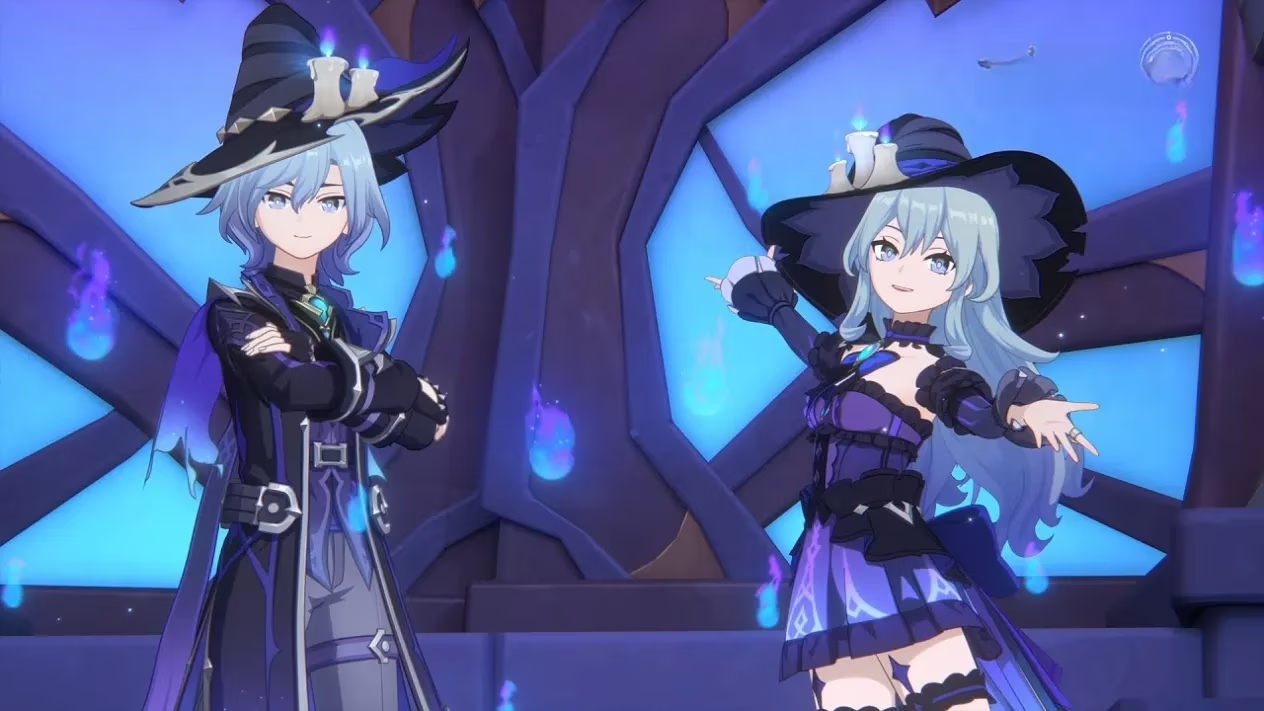
Access is strikingly simple. The mode unlocks almost immediately \u2013 right around the time the Wish system becomes available in the opening Archon Quest. That means anyone actively playing Genshin can dive into Wonderland without grinding through dozens of hours of story. Once inside, players step into the role of a Manekin, a brand-new customizable character that becomes their avatar for all creator-made content. The Manekin can even be used in the open world (though not in Spiral Abyss, Imaginarium Theater, or Stygian Onslaught), carrying elemental abilities tied to the Traveler\u2019s current loadout. But combat isn\u2019t the star here; it\u2019s all about style.
Dressing up the Manekin is a core part of the experience. HoYoverse, which has notoriously released very few premium character skins over five years, seems to have dumped a wardrobe\u2019s worth of options into Wonderland. Outfits can be unlocked through activities, crafted from blueprints after gathering materials, or drawn from a dedicated cosmetic banner. That banner uses a separate currency called Geodes of Replication, earned via weekly challenges, rank-ups, events, and the Wonderland battle pass. Some outfits are limited-time only (reruns remain unconfirmed), while others wait behind crafting recipes. Players can tweak individual clothing pieces and accessories or equip whole premade sets. There are even temporary rental vouchers so friends can try on rare looks before committing.
The creation tools are pleasantly approachable. Using an array of assets, terrain brushes, enemy spawners, and a visual logic system that resembles Unreal Engine\u2019s behavior trees, builders can drag and drop worlds together without writing a single line of code. HoYoverse seeded the mode with \u201chundreds\u201d of stages at launch, covering sim management challenges, party games, PvP battles, and full-on adventure maps. Player-made levels appear on a revolving curation system where popularity and ratings directly affect how much their creators earn.
Money, of course, is where things get interesting. Miliastra Wonderland has its own paid battle pass, though owning the standard Genshin battle pass grants the Wonderland version for free \u2013 a small mercy confirmed on the English reveal stream. The \u201cCreator Earnings System\u201d that rewards top designers still hasn\u2019t been fully explained, but a major expansion to the payout structure arrives (or already arrived, depending on when you\u2019re reading) with the Luna IV patch in version 6.3. As a player\u2019s Craftsperson rank climbs, new editing options and stage features unlock, making the mode deeper the more you invest.
What\u2019s unclear is how much the mode feeds back into Genshin\u2019s primary progression. It doesn\u2019t shower you with Primogems, character ascension materials, or resin \u2013 at least not in obvious ways. The focus stays on cosmetics, creativity, and social bragging rights. Many purchased or crafted outfits can be shared with friends, encouraging a vibrant, dress-up-driven community that stands apart from artifact grinding.
Industry watchers saw this coming. Roblox regularly dwarfs Steam\u2019s daily active users, Fortnite keeps expanding its creative ecosystem, and Minecraft remains a titan of player-built worlds. It makes perfect sense for HoYoverse to use Genshin Impact\u2019s massive player base to test a UGC layer. The company is likely hoping Wonderland pulls in younger players who might bounce off the gacha grind, giving them a self-sustaining playground that demands minimal developer maintenance once the editor tools are out the door. For veteran Travelers, it offers repeatable content that never quite feels the same twice, provided the community keeps building.
Whether it will truly click with the wider Genshin audience is still being written. The tools are friendly, the cosmetic bait is generous, and the variety of game types already goes far beyond what anyone expected from a side mode. But Miliastra Wonderland\u2019s long-term success hinges on how deeply HoYoverse weaves it into the game\u2019s reward systems and whether the creator payouts become genuinely motivating.
For those still chasing combat power, update 6.1 also made history by handing out free 5-star Constellations for the first time in five years \u2013 a move that had FOMO written all over it. Yet, nestled beside that headline, Wonderland feels like a quieter, bolder bet on the future. It\u2019s an invite to stop optimizing and start playing pretend, and that might just be the breath of fresh air Teyvat needed.